By Alonzo Harvey and Colleen V. Chien
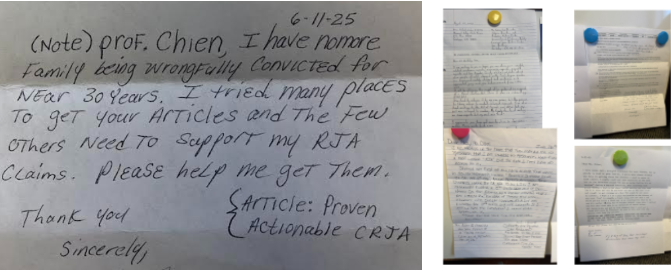
Examples of Letters received by the Paper Prisons Initiative
The Judicial Council of California is proposing, as described in its invitation to comment W26-05, to change Form HC-001, the official Petition for Writ of Habeas Corpus used in California courts. Form HC-001 is a form that can be used by people in prison or their lawyers to ask a court for a writ of habeas corpus, allowing them to challenge their imprisonment by arguing that their constitutional rights were violated or that their conviction is legally flawed.
An impetus for this change is to make the form easier to use in cases involving the Racial Justice Act (RJA), which prohibits the state from charging, convicting, or sentencing someone based on their race, ethnicity, or national origin. The Paper Prisons Initiative, based on consultation and experience with prisoners who would be the beneficiary of these changes, applauds the Council, and in particular the Honorable Appellate Advisory Committee Chair Hon. Allison M. Danner and Criminal Law Advisory Committee Chair Hon. Lisa Rodriguez for this important step to increase access to justice in support of the principle of equal access to the law.
Below we summarize the changes that are being proposed and provide our comment, which makes the following points: such efforts, to make such forms for pro se defendants easy to use, are vital; however, they are not sufficient, as accessing the type of data and evidence that RJA claims require from within prison particularly when internet access is limited is extremely fraught. Even if these steps can be surmounted, the challenges of applying the new law and its evolving evidentiary standard are significant, requiring appointment of counsel, an option newly invigorated by AB1071, which cites California Supreme Court Justice Goodwin Liu’s dissent in the in re Mendoza case, in its development of the law.
A Lay Summary of What the Proposed Changes Do
Clearer Organization: The new version of the form will be split into three clear parts:
- Part A: Basic info (Name, Case Number, etc.) that everyone must fill out.
- Part B: For “standard” legal claims.
- Part C: A new section only for Racial Justice Act claims. This helps keep the different legal arguments distinct.
People also often felt they didn’t have enough space to explain complicated racial bias claims. The new form adds extra space specifically for these details.
A few other features:
- Checking for Evidence (Discovery): The revised form asks, “Have you already tried to get evidence for this claim?” This will help judges decide if the court needs to step in and order the police or prosecutors to hand over files through “discovery”.
- Access to Attorneys: Since the law says indigent (low-income) people have a right to a court-appointed lawyer if they make a strong enough claim, the form adds questions to help the judge determine if the petitioner needs a free attorney.
- Notification of Police Agencies: If a person is accusing a specific law enforcement officer of racial bias, the new rules require the lawyer to send a copy of the form directly to that officer’s department so they are aware of the claim.
The goal is streamline and clarify the judicial process, and dismantle the “paper prisons” that prevent people from bringing meritorious habeas claims without clogging the courts with unsupported claims. By giving people a specific “Part C” for RJA claims, the court can more quickly identify which cases are serious and deserve a hearing, and which ones lack the necessary proof.
***Our Comment
The Paper Prisons Initiative of UC Berkeley and based at Berkeley Law is a research initiative that uses data, research, and empathy to bridge the gap between eligibility and delivery of relief from the criminal justice system. We appreciate this opportunity to comment on the form changes proposed by Hon. Allison Danner and Hon. Lisa Rodriguez.
We provide the attached comment based on two capacities. First, our impacted expert advisor Alonzo Harvey has provided a testimony based on his own experiences being incarcerated and a leader in the formerly incarcerated student movement, about the merits of the form – in its simplicity and clarity and also with respect to the reality that the data to actually fill the form as part of a pattern of disparity of claim is generally glaringly unavailable to the pro se defendants who might use them, due to lack of access to the internet and other sources of information. His testimony calls for greater access to data resources like the Paper Prisons Racial Justice Act Tool so that pro se individuals may evaluate their claims and the court can determine whether counsel should be appointed. Please see Mr. Harvey’s attached declaration, “The RJA Is a Lifeline But Only If People Inside Can Access the Tools to Use It.”
Second, we are the creators of the Paper Prisons Racial Justice Act Tool (rja.paperprisons.org), which provides provides summary data representing the raw numbers, rates per population, and disparity gaps by race of adults in the California criminal justice system using data provided by the California Department of Justice as well as by the Census Department. Access the Census data here. (See Proving Actionable Racial Disparity Under the California Racial Justice Act, 76 UC L. Journal 1 (2023); see also The Paper Prisons Racial Justice Act Data Tool, 29 Berkeley J. Crim. L. 29 (2024) and visit rja.paperprisons.org) In this capacity, we regularly interact with pro se defendants and their loved ones seeking to use our data to evaluate whether or not their case fits a broader pattern of racial disparity. Our correspondees range from the 18-year old daughter to lifers who have “noone” (sic) still to help them in their cases, which they insist they are currently wrongfully incarcerated in connection with. (see [omitted]) While we did not have time to ask our correspondents for their opinion of the form changes, we note that three problems beset this population: (1) lack of understanding of the legal standard, (2) lack of understanding of data and how it applies in the legal context, and (3) lack of access to data. Your new form makes considerable progress in advancing the first, we try to advance (3) through our tool. But (3) is difficult when there isn’t access to the internet and data archives within prisons and neither of us can accomplish (2). We in particular have been humbled that, despite our efforts, our correspondees still struggle to understand how data works and can be leveraged to determine the viability of their claims, in habeas cases, for freedom.


